
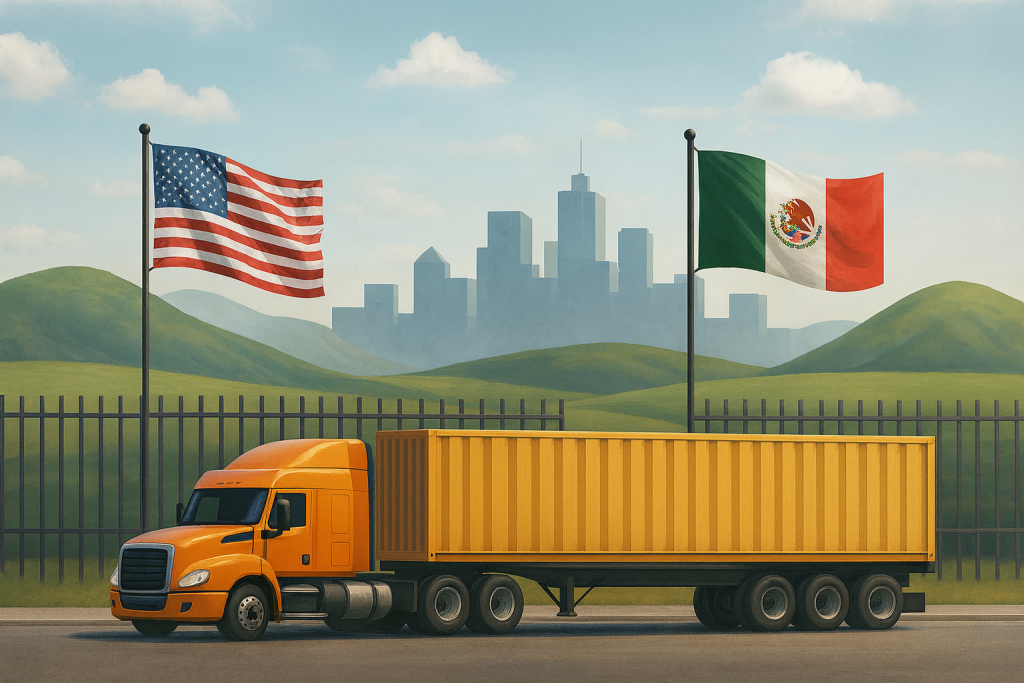
As your business evolves, your needs will too. You may find yourself sourcing products from Mexico or chasing a new customer base there. A turbulent global supply chain and rocky trade relations have driven many companies to look elsewhere. While labor and manufacturing costs may always favor Asia, you can’t ignore the faster transit times and strong, evolving workforce in Mexico—or the fact that it’s on track to become a trillion-dollar trade market with more stable lanes.
Whether your sales team just landed a customer in Monterrey or your purchasing department is exploring suppliers in Querétaro, it’s usually the logistics team who gets tapped to figure it out. And fast. But cross-border shipping isn’t plug-and-play. Here’s what to keep in mind if you want to avoid costly mistakes.
Location, Location, Location
Where you source from in Mexico matters—a lot. Proximity to the border affects everything: transit time, theft risk, cost, and quality of carrier capacity.
If you’re sourcing from a manufacturer, find out where the facility is. Is it a maquila? Are they C-TPAT certified? What quality certifications do they carry? What state are they in? Most importantly—who else ships out of that facility? Get 3–5 references if you can.
If you’re shipping to a distributor in Mexico, choose a hub close to the border, like Monterrey or somewhere in the Bajío region. Monterrey is only a 3.5-hour drive from Laredo, which keeps risk and transit time low.
If that’s not an option and you’re delivering to customers across the country, consider how many border ports you’ll need. More ports = more customs brokers and warehouse partners. Run a cost analysis across your destination markets using different border crossing options.
Control Can Be King
One mistake we see all the time? U.S. companies giving up transportation control at the border.
In some cases, the supplier or customer or customs broker takes over at the border—and while that may sound easier, it usually means higher costs and lower priority for your freight. We’ve seen lanes cost 3x the market rate and take twice as long, all while getting poor communication and long customs delays.
Yes, taking control means doing more upfront. But with the right partners and a solid step-by-step process, that learning curve shrinks fast. You’ll gain transparency, reduce costs, and actually stay in the loop.
Customs Is a Language Worth Learning
Picking the right customs broker is critical. Mexico-U.S. customs isn’t like Canada. There’s more paperwork, more moving parts, and more potential for delay.
Start by understanding the steps for Mexico–U.S. and U.S.–Mexico shipments. (We break this down in our article “Shipping Cross-Border Mexico: What paperwork is needed to clear the border?” on our blog.)
Next, source the right broker based on your equipment, volume, industry, and which border port you’re using. Every crossing requires a broker licensed at that specific port—and you need both a U.S. and Mexican broker. Most U.S. customs brokers working the southern border have a partnered Mexican broker, so you’ll likely work with one unified team.
Heads-up: it takes 7–10 days to get customs setup finalized. The toughest part is getting your supplier, customer, or manufacturer set up on the Mexican broker’s side. To avoid headaches, do a dry run:
– Share a BOL, packing list, and commercial invoice with your carrier
– Share HTS codes and any other relevant info for the Carta Porte document
– Make sure all paperwork is sent to the customs broker ahead of time
– Coordinate timing and responsibilities between broker and carrier
Trucks at the border usually get 2–3 days free. After that, detention fees start racking up fast.
Set Expectations Early
Most people involved—sales, purchasing, ops, even leadership—are experts in their field, but not in cross-border logistics. Your job is to set expectations early and clearly. Walk them through what needs to happen, where the bottlenecks may be, and how the timeline might fluctuate. Communication here goes a long way.
Traps to Avoid:
– Suppliers or customers in Mexico insisting on controlling transportation. They may be trying to pad their margins.
– Customs brokers who aren’t licensed at your chosen port and rely on a partner. Find one that’s licensed directly to avoid delays.
– Logistics providers with no references or limited experience. Mexico freight is not a place to wing it.
– Facilities in remote areas offering big cost savings. This usually leads to poor carrier coverage, longer transit, and higher theft risk.
– Choosing smaller ports to avoid congestion. Larger ports like Laredo, Tijuana, and El Paso have better infrastructure, capacity, and pricing.
– Underestimating transportation and customs costs. Add 3–5% buffer to cover hidden costs, taxes, and duties.
Mexico is full of opportunity—but success starts with understanding how the supply chain really works south of the border. Hoplite can help you get it right the first time.

